
The NHL’s Standings Problem: How a System Built for Stability Is Limiting the League’s Growth
Why the NHL’s points system and playoff format create confusion, limit growth, and how a new model could better reward winning and performance.


The NHL is one of the most compelling leagues in sports. Its speed is unmatched, star power exists in every market, and the Stanley Cup Playoffs remain one of the most demanding postseason formats in professional sports.
And yet, despite all of this, the league has a fundamental problem.
The NHL’s point distribution system and playoff seeding structure are difficult to understand for new and casual fans.
In this article, James Romain and I explore what would happen if the NHL rethought both its point system and playoff seeding model, using historical data alongside business and fan-experience considerations.
With that context in mind, let’s dive in.
How the Current NHL System Works
To understand how the NHL might improve its standings system, we first need to examine how it currently works. Under the NHL’s current 2–1–0 point model, teams receive two points for any win, one point for an overtime or shootout loss, and zero for a regulation loss.
Playoff qualification prioritizes divisions, with the top three teams in each division qualifying automatically, followed by two Wild Card teams per conference. First-round matchups are determined by divisional placement rather than overall record.
Why the System Exists and Where It Falls Short
The current structure succeeds in one key area: market stability. By keeping more teams in contention deeper into the season, the league maintains fan engagement, attendance, and local media interest. Divisional playoff matchups also create familiar, marketable narratives that broadcasters can easily promote. In a gate driven league stability like this is extremely important.
However, that stability comes at a cost.
Parity in the NHL is no longer purely competitive, it is structurally manufactured. Regulation wins are rewarded no more than overtime or shootout victories, meaning teams that consistently dominate receive little advantage over teams that simply reach extra time. This uneven point distribution encourages conservative late-game play, dulls regulation intensity, and compresses the standings, blurring the line between elite teams and average ones.
Compounding the issue, the system is difficult to explain. Uneven point totals, divisional priority, and Wild Card rules create friction for new and global fans in a sports landscape increasingly driven by accessibility. That’s where our proposed model comes in.
A New Proposed System
With the shortcomings of the current model in mind, we believe a 3–2–1–0 point distribution model offers a clearer and more effective solution. Under this structure, regulation wins would earn three points, overtime or shootout wins two, overtime or shootout losses one, and regulation losses zero. Every game would distribute exactly three points, bringing consistency and transparency to the standings.
Playoff qualification would be simplified as well. The top eight teams in each conference would qualify regardless of division, with matchups determined strictly by record. This ensures season-long performance is properly rewarded and playoff paths reflect merit rather than geography.
And this isn’t just theoretical. To test how this system performs in practice, we brought in James to analyze the current system and compare it to our new model.
Comparing the Two Systems: What Actually Changes
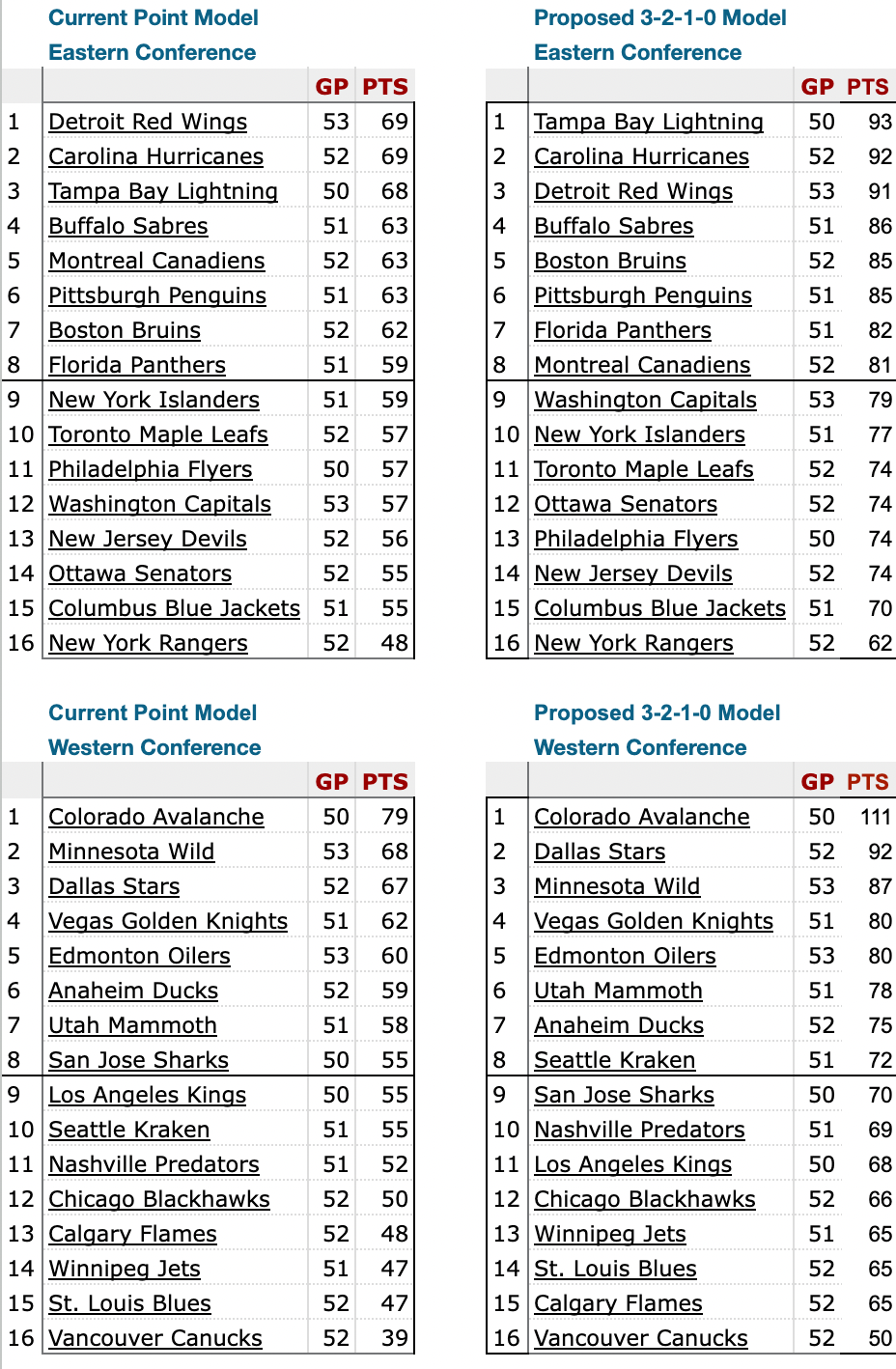
To move beyond theory, James recalculated the standings using the proposed 3–2–1–0 model and applied it directly to historical data. The result isn’t chaos or dramatic reshuffling, but clarity.
Under the current system, point totals are heavily compressed. Teams separated by only a few points often sit on opposite sides of the playoff line, creating the appearance of parity while masking real performance gaps. James’ recalculations show how this compression is largely driven by overtime point inflation rather than regulation dominance.
Under the revised model, that compression eases. Teams that consistently win in regulation begin to separate themselves, while teams relying on overtime lose artificial ground. In the Eastern Conference, Tampa Bay’s rise reflects decisive wins rather than extra-time accumulation. In the West, Colorado’s position more clearly reflects sustained control rather than marginal point advantages.
Parity isn’t eliminated, it’s recalibrated. James’ work shows that competitive clusters still exist, but they are built around regulation success instead of point inflation. The standings remain competitive, but they tell a more honest story about which teams are actually driving play.
Why the New System Better Serves the NHL’s Future
When the shortcomings of the current model are viewed alongside historical examples, the conclusion becomes clear. A simplified structure lowers barriers for new and casual fans. Standings become intuitive, playoff qualification becomes logical, and fans can immediately understand not just where teams rank, but why they rank there.
More importantly, winning matters again. By placing real value on regulation victories, urgency is restored across the entire schedule rather than being concentrated late in the season. Changing incentives also unlocks innovation. Teams are encouraged to take risks, late-game strategies evolve, and the on-ice product becomes more dynamic, all without altering the rules themselves.
Aligning the NHL’s point system with international standards further positions the league as a global product, especially as NHL players return to the Olympic stage. Familiar structures reduce friction for international audiences and strengthen the league’s global identity.
Ultimately, a revised system formalizes what the NHL already values. Regulation wins are already the league’s primary tiebreaker. Updating the point structure simply aligns the standings with that philosophy, fully committing to excellence, decisiveness, and merit.
Closing Thoughts
This piece reflects myself and James’ take on the NHL’s current standings system, specifically how parity, overtime points, and incentive structures may be shaping the game in ways the league didn’t originally intend. What started as a simple question about fairness quickly turned into a deeper conversation about competitiveness, storytelling, and what kind of hockey the NHL wants to reward.
At its core, our argument is simple: winning in regulation should matter more. A clearer points system would better reflect true performance, encourage aggressive play, and tell a more honest story over the course of a season, even if that means fewer “manufactured” playoff races along the way.
We had a lot of fun putting our heads together on this one, balancing the fan experience with the business realities of the league. Our goal isn’t to claim the NHL has it wrong, but to ask whether a system built for stability is still serving the league’s future.
We’d love to hear what you think. And this definitely isn’t the end, you can expect more collaborations between James and myself moving forward!